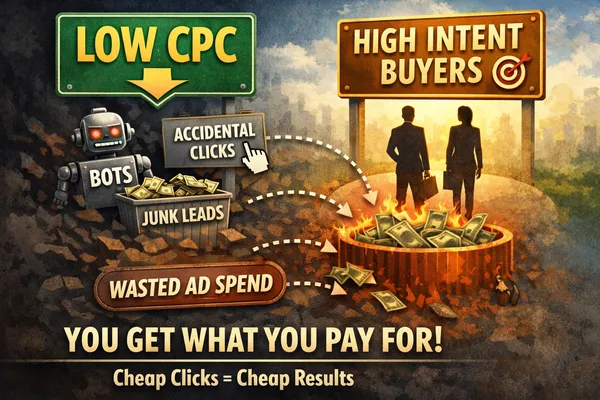
The Hidden Cost of Cheap Clicks: Why Search Partner Networks Hurt Lead Quality
A common mistake business owners make is believing that lowering their cost per click will bring more qualified traffic to their website while spending less money.
When setting up campaigns in Google Ads or Microsoft Ads, advertisers often notice an option called “Enable Search Partners.” Enabling search partners can increase traffic volume and frequently lowers the average cost per click. In some cases, it may even reduce the reported cost per lead.
However, this lower cost often comes at a hidden price.
Instead of producing more qualified buyers, search partner networks can introduce lower-intent traffic, accidental clicks, and automated bot activity, all of which consume advertising budget without generating real customers.
To understand why this happens, it helps to look at how online advertising traffic actually works today.
A Large Portion of the Internet Are Bots
One of the biggest challenges in digital advertising today is the amount of automated (bot) traffic on the internet.
Research shows that 51% of all internet traffic is generated by bots rather than humans, and about 37% of total traffic comes from malicious “bad bots.”
Bot activity has increased consistently for several years, driven by automation tools and AI. Bots perform many actions online that look similar to human behavior. They can visit websites, scrape information, load pages, and even click advertisements. For advertisers, that means some portion of campaign traffic may not come from real people at all.
This becomes particularly relevant when ads are distributed across large partner networks where traffic quality can vary widely.
Click Fraud and Invalid Traffic Affect Many Ad Campaigns
Analysts estimate that as much as 30% of advertising spend can be lost to fraudulent or invalid clicks.
Invalid traffic can include several sources:
automated bot clicks
click farms generating artificial engagement
accidental clicks on mobile devices
fraudulent traffic networks
When these clicks occur, the advertiser pays for traffic that never had real purchase intent.
Accidental Clicks Are Common on Mobile
Another issue with partner networks is incidental clicks, particularly on mobile devices.
When ads appear inside apps or near interactive content, users sometimes tap them unintentionally while scrolling or navigating the screen.
Google itself defines invalid traffic as including accidental clicks that do not represent genuine user interest.
In practice, this often looks like:
a user taps an ad while scrolling
the landing page opens
the visitor immediately leaves
The advertiser still pays for that click, even though there was never any real intent behind it.
The Cheap Click Trap: Why Intent Matters More Than CPC
One of the most common mistakes advertisers make is becoming overly focused on lowering cost per click. When search partner networks are enabled, campaigns often show cheaper clicks and increased traffic volume, which can make performance appear better at first glance.
But advertising markets price traffic based on intent. High-intent searches—where someone is actively looking for a service—are usually more competitive and therefore more expensive.
Examples of high-intent searches include:
“performance TH400 transmission for sale”
“machine shop near me”
“fix flat tire near me”
These searches happen on the main search engine, where the user has a clear problem they are trying to solve. Because the intent is strong, these clicks often produce higher conversion rates and real customers.
“You get what you pay for” holds true when it comes to digital ad placement.
When ads are distributed across search partner networks and other syndicated placements, the traffic frequently comes from environments where intent is weaker, accidental clicks are more common, or click fraud traffic may be present. Cheap clicks are often cheap because the user was never seriously looking for the service in the first place.
A more effective strategy is not to chase the lowest possible click cost, but to improve efficiency within high-intent searches. Optimizing landing pages, improving ad relevance, and aligning keywords closely with the services being offered can increase quality scores and often lower cost per click while maintaining strong buyer intent. In other words, advertisers can reduce costs by improving efficiency rather than expanding into low-quality traffic sources.
It is also important to remember how advertising platforms make money. Google and Microsoft generate revenue every time someone clicks an ad. Their networks contain millions of available ad placements that need to be filled, and expanding distribution through partner networks helps maximize that inventory.
For businesses owners, however, the goal is different from Google's. The objective is not simply to generate more clicks—it is to generate profitable customers. Keeping campaigns focused on high-intent searches and improving landing page performance typically produces far better long-term results than chasing the lowest possible CPC across the internet.
